Can One Propane Tank Supply a House and Detached Garage?

Adding heat to a detached garage raises a practical question: can your home’s propane tank handle another building, or will you need a second tank? Yes, one propane tank can supply a house and detached garage when a qualified professional designs the system for both buildings. The deciding factors include combined appliance demand, cold weather, gas line length, pressure regulation, and local installation rules. A tank that already heats your home does not automatically have enough capacity for a garage heater. An undersized supply can leave appliances short of fuel flow when both buildings need heat. Before buying equipment or digging a trench, understand what your existing system can support and which changes would make a shared supply practical.

Overview

  • One propane tank can supply both buildings with proper sizing.
  • Check combined appliance demand and cold-weather capacity.
  • Gas line length, size, and regulators affect fuel delivery.
  • Garage heating increases fuel use and refill frequency.
  • Have a qualified professional design and test the system.
Can One Propane Tank Supply a House and Detached Garage? | LP Propane

Can One Tank Serve Both Buildings?

Shared Fuel Supply

A shared propane supply uses one storage tank to deliver fuel through piping branches to separate buildings. The tank stores liquid propane, which changes into vapor for typical residential appliances. Each branch must deliver the fuel flow and pressure its equipment needs, even when equipment in the other building starts.

Combined Appliance Demand

Combined appliance demand is the total fuel input of equipment that the system must support. Manufacturers express input in British thermal units per hour, or BTU/h. For example, a 100,000-BTU/h furnace, 40,000-BTU/h water heater, and 60,000-BTU/h garage heater create a combined input of 200,000 BTU/h before other appliances.

Cold Weather Capacity

Cold weather reduces the heat available to change liquid propane into vapor. Vaporization capacity means the rate at which a tank can produce that gas. A shared system may work during mild weather yet struggle when the house furnace and garage heater run together during a cold snap.

Actual Tank Capacity

A nominal 500-gallon residential tank typically holds about 400 gallons at an 80% fill level. The remaining space allows liquid expansion. That storage figure does not prove the tank can serve both buildings: a professional must also check its cold-weather vapor production against the appliances’ hourly demand.

Garage Distance

A longer piping route increases resistance to gas flow, so distance affects pipe sizing and pressure design. A garage 100 feet away may need a different arrangement than one 25 feet away. These distances illustrate the design issue; neither creates a universal cutoff for sharing a tank.

Existing Tank Location

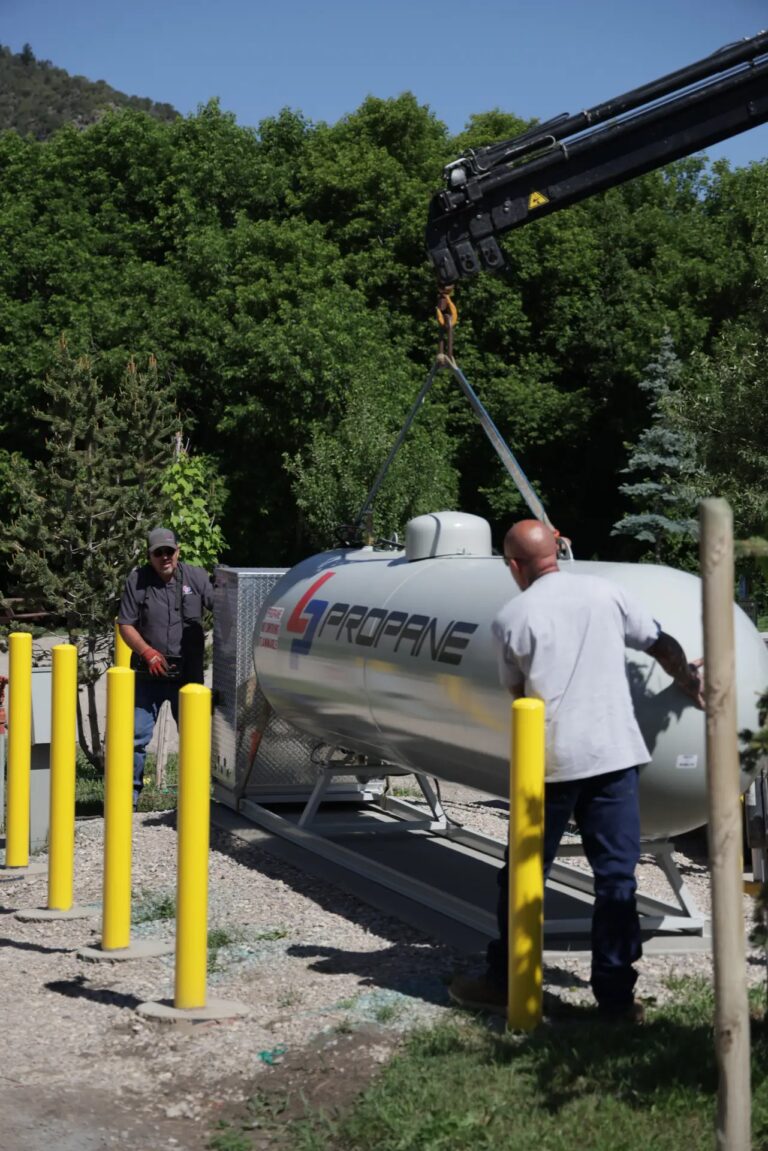
Your current tank may stay if its location, condition, capacity, and access meet the expanded system’s needs. For a leased tank, contact the supplier before planning changes. Adding a garage changes the connected demand, so the supplier needs to review whether the existing equipment remains suitable.

Keep both buildings warm with one planned supply

How Do Gas Lines and Regulators Serve a Detached Garage?

Separate Regulators

Some shared systems use a first-stage regulator at the tank and separate second-stage regulators near the buildings. A regulator reduces and controls gas pressure. This arrangement can suit separate branches, but the installer chooses the layout based on approved equipment, appliance requirements, and applicable codes rather than building count alone.

Existing Line Capacity

You may be able to extend the house’s gas line if it has enough capacity for the added garage load. A line designed for a small appliance may not support a 60,000-BTU/h heater. The installer checks upstream piping and regulators because every shared section must carry the additional demand.

Gas Line Sizing

There is no single pipe size that fits every detached garage. Professionals use sizing tables that account for fuel type, delivery pressure, pipe material, length, and connected input. Asking whether a half-inch line will work leaves out the conditions that determine its capacity; provide the full route and heater rating instead.

Underground Gas Lines

An approved underground gas line can connect the tank system to the garage. Material, burial depth, protection, and transitions depend on the design and local requirements. Arrange utility locating before excavation, including private lines that a standard location may not cover. A licensed installer should specify the trench before digging begins. 

Garage Shutoff Valves

The design can provide an accessible garage branch shutoff along with required appliance shutoffs. This allows a professional to isolate the garage for service when the system arrangement permits it. Ask the installer to label the valves and explain which equipment each controls before handing over the completed system.

Testing Before Startup

The installer completes the required piping tests, leak checks, and appliance startup checks before placing the addition into service. Checking operating pressure while connected equipment runs helps reveal supply restrictions. Ask for permit approvals, test records, and equipment information so future technicians can understand the two-building system.

How Do You Plan Garage Heating Without Disrupting House Service?

Garage Heater Sizing

A heating contractor should calculate heat loss before selecting the heater. Heat loss is the rate at which heat escapes through the building and incoming outdoor air. Two 600-square-foot garages can need different equipment because insulation, ceiling height, outdoor temperature, and frequently opened overhead doors change that loss.

Hourly Propane Use

A heater with a 60,000-BTU/h input burns approximately 0.66 gallons per hour at full input, using an energy content of approximately 91,452 BTU per gallon. Three full-input burner hours use about 1.97 gallons. This example measures burner operation, not three hours with the thermostat switched on.

Added Heating Costs

Multiply estimated gallons by your delivered propane price. At an illustrative $3 per gallon, 1.97 gallons costs about $5.91 in fuel. Repeat that usage for 20 days and the example reaches about $118.20. Actual costs depend on burner runtime, weather, insulation, thermostat settings, and any service charges.

Delivery Schedule Changes

Garage heating increases withdrawals from the shared tank, so your old delivery pattern may no longer fit. Tell the supplier when the heater starts operating and whether you use it daily or only on weekends. Ask about the supplier’s reorder level and lead time; another building can change when you need a refill.

Suitable Garage Heaters

Choose an appliance approved for the garage application and install it according to its instructions and local rules. Direct-vent equipment draws combustion air from outside and sends exhaust outdoors. The installer must also account for gasoline vapors, vehicle movement, mounting requirements, and vent locations; a fuel connection alone does not make a heater suitable.

Propane Leak Response

Leave the affected area immediately if you smell propane, and avoid flames, switches, vehicles, and phones near the suspected leak. From a safe location, contact your propane supplier or emergency services. Do not return or restart equipment until responders or a qualified professional say it is safe.

Is One Shared Tank Cheaper Than Two Separate Tanks?

One shared tank may cost less when the existing supply has spare capacity and the garage is easy to reach. A long trench, driveway crossing, or major piping upgrade can make a separate garage tank more practical. Compare itemized quotes for both options, including installation, permits, restoration, rental charges, and delivery arrangements. Sharing a tank does not reduce the heater’s fuel consumption; it changes how you store and deliver that fuel.

What Should You Prepare Before Requesting an Installation Quote?

Gather the tank’s capacity and ownership details, photographs of accessible equipment labels, and the proposed heater’s model and input rating. Sketch the house, garage, tank, and approximate route, marking driveways and other obstacles. Ask the contractor to confirm tank vapor capacity, piping and regulator changes, permits, testing, and responsibility for trench restoration. Local officials determine which permits and inspections apply under adopted fuel gas and propane installation codes. Mention any future generator or water heater now so the design can account for planned demand.

Plan the Shared System Before Buying the Garage Heater

One propane tank can supply a house and detached garage when the complete system can handle both buildings at the coldest design conditions. Arrange a site assessment before choosing a heater or scheduling excavation. Ask a qualified propane professional to review your existing supply and discuss the garage addition. Start with your appliance ratings and property layout so the next decision follows a site-specific plan.

BLAZING BLOGS

Can One Propane Tank Supply a House and Detached Garage? | LP Propane

How Much Propane Does a Garage Heater Use?

How Much Propane Does a Garage Heater Use? A warm garage makes winter projects more comfortable, but estimating the fuel bill takes more than checking the heater’s size. A propane garage heater rated between 40,000 and 100,000 BTU per hour

Read More »

State Fair Giveaway

$500 Worth of Propane

Be one of the first 200 New Customers to sign-up until September 15th to get $500 worth of propane, FREE! You’ll also get 1 year free tank rental when you switch!

JOIN THE IGNITE PROGRAM

NEW CUSTOMER? Fill out the New Customer Application to join IGNITE.

Save $0.05 Per Gallon with the IGNITE Program Learn more!

This field is for validation purposes and should be left unchanged.
Name(Required)
Service Address(Required)
AAP Agreement(Required)
You will be contacted by a Customer Service Representative to obtain your credit card information.
Terms of Service(Required)

LP Propane Ignite Program – Terms and Conditions

1. Eligibility and Program Requirements
To qualify for and maintain enrollment in the LP Propane Ignite Program and receive the $0.05 per gallon fuel discount, the Customer must simultaneously enroll in and maintain active status in the following three core services:

Auto Fill Delivery: The Customer authorizes LP Propane to automatically monitor, schedule, and deliver propane to the designated tank when levels dictate, bypassing the standard Will Call scheduling requirements.

Auto Pay: The Customer must maintain a valid, authorized payment method on file (Credit Card, Debit Card, or ACH/Direct Draft). Invoices will be automatically drafted within 7 days after the delivery.

Paperless Billing: The Customer agrees to receive all invoices, statements, and program communications via email. Opting out of online billing or requesting paper statements will result in a $4.95 monthly fee and disqualification from the program.

2. Fuel Discount Terms

The $0.05 per gallon discount applies exclusively to the standard market rate of propane at the exact time of delivery.

The discount is applied automatically on invoice.

This discount cannot be combined with specific commercial contract pricing or volume discounts unless expressly authorized in writing by LP Propane.

3. Tank Monitoring and Delivery Access

LP Propane may utilize physical tank monitors or advanced usage-tracking algorithms to schedule deliveries.

Access Requirements: The Customer must ensure the propane tank is always completely accessible to delivery personnel and vehicles. The pathway must be free of obstacles, locked gates, debris, or unrestrained animals within a 100-foot radius.

Seasonal Maintenance: During winter months, the Customer is legally responsible for clearing snow, ice, and paths leading to the tank. If a delivery vehicle cannot safely access the tank, the delivery will be delayed, and any emergency filling fees incurred due to subsequent low fuel levels will be billed to the Customer.

4. Credit Status and Payment Failures

If an Auto Pay transaction is declined or fails for any reason (e.g., expired card, insufficient funds), the Customer must update their account billing details immediately. If the transaction remains unprocessed for 30 days despite attempts by LP Propane to contact the Customer, the account will be automatically unenrolled from the program.

If an account balance becomes past due, LP Propane reserves the right to suspend Auto Fill privileges, pause the $0.05 per gallon discount, and transition the account to a "Will Call / Cash on Delivery" basis until the account is brought current and after review and approval of LP Propane’s credit department.

5. Program Termination or Changes

Customer Termination: Removing any of the mandatory components (Auto Fill, Auto Pay, or Paperless Billing) constitutes voluntary termination from the program. If you would like to opt out of the Ignite program you must submit 30 day written notice

Company Modifications: LP Propane reserves the right to alter, modify, or terminate the Ignite Program framework, including discount amounts or underlying eligibility terms.

MM slash DD slash YYYY