How Do You Plan Propane Supply for a Long Power Outage?

A propane generator can keep essential equipment running during a blackout, but its fuel demand can surprise homeowners after the first day. A generator consuming 2.5 gallons per hour uses 60 gallons in 24 hours, before you count the furnace, water heater, or other propane appliances. Planning for a long outage therefore requires more than checking whether the tank looks full. You need to know your generator’s consumption, the equipment you must power, the fuel available above your reserve, and whether deliveries can reach you after a storm. Start with several outage scenarios rather than one promised restoration time. A practical plan connects stored fuel, expected operating hours, household heating needs, and a backup decision if the outage lasts longer than expected.

Overview

  • Multiply your generator’s gallons per hour by expected runtime to estimate fuel needs.
  • Add propane demand from heating and other connected appliances.
  • Calculate available fuel above a supplier-approved reserve.
  • Arrange deliveries early and reduce unnecessary electrical loads.
  • Prepare for maintenance, delivery delays, and safe relocation if fuel runs low.
How Do You Plan Propane Supply for a Long Power Outage? | LP Propane

How Much Propane Will Your Generator Need?

Find the Fuel Rating

Look in the specification sheet or owner’s manual for propane consumption in gallons per hour. Manufacturers may list separate figures at half load and full load. Confirm that you are reading propane consumption rather than natural gas consumption, which commonly appears in cubic feet per hour.

Understand Electrical Load

Electrical load is the power your connected equipment draws from the generator. A 20-kilowatt generator supplying 10 kilowatts operates at approximately half its rated output. Refrigerators, pumps, and heating equipment cycle, so household demand changes even when the generator runs continuously.

Compare Consumption Rates

Published specifications for one 22-kilowatt standby generator list approximately 2.53 gallons hourly at half load and 3.90 gallons hourly at full load. Those rates illustrate why load matters; they do not apply to every 22-kilowatt unit. Use your model’s documentation for the actual calculation. 

Calculate Daily Demand

Multiply the selected consumption rate by daily operating hours. At an assumed 2.5 gallons per hour, continuous operation requires 60 gallons daily. Running for 12 hours would use about 30 gallons at that same rate, but scheduled shutdowns must fit your equipment, household needs, and manufacturer instructions.

Model Longer Outages

Calculate at least three-day and seven-day scenarios. At the illustrative rate of 60 gallons daily, those periods require 180 and 420 gallons, respectively, for the generator alone. A restoration estimate can change after crews discover additional damage, so your plan should include a longer-outage option.

Allow for Changing Demand

Create a second calculation for heavier electrical use rather than assuming one average remains constant. At 3.9 gallons per hour, 24 hours of operation consumes 93.6 gallons. Cold weather, air conditioning, or increased pump operation can change the load and shorten the fuel coverage you expected.

Plan your propane before the power goes out

How Much Fuel Is Actually Available in Your Tank?

Confirm Tank Capacity

Check the tank identification plate or ask your supplier to confirm its nominal size. A nominal 500-gallon tank commonly holds about 400 gallons at an 80% fill level. Expansion space accounts for the difference, so do not build a fuel plan around filling the tank to its nominal capacity.

Read Current Inventory

The tank gauge gives an approximate percentage of nominal capacity containing liquid propane. A 500-gallon tank reading 60% contains roughly 300 gallons. Gauge accuracy and temperature affect the reading, so treat that calculation as a planning estimate rather than an exact inventory measurement.

Establish a Reserve

Ask your supplier what minimum level and reorder point suits your system, consumption, and delivery conditions. For illustration, maintaining a 30% reserve in a 500-gallon tank leaves about 150 gallons. That example is a planning threshold, not a universal emergency operating limit.

Separate Generator Fuel

Subtract the planned reserve from current inventory before calculating generator coverage. If the example tank contains 300 gallons and you set aside 150, only 150 gallons remain in the planning allowance. At 60 gallons daily, that supports approximately 2.5 days, before other propane demand.

Include Household Appliances

Add fuel used by the furnace, boiler, water heater, fireplace, and other equipment that will operate during the outage. If the generator needs an assumed 60 gallons daily and household appliances need eight, total demand becomes 68 gallons daily. Avoid counting the same fuel demand twice when reviewing supplier estimates.

Check Vapor Supply

Vaporization is the process that turns stored liquid propane into the gas many standby generators burn. A professional must check whether the tank can support the combined appliance demand, particularly in cold weather and at lower fill levels. Enough stored gallons do not automatically establish adequate hourly fuel delivery.

How Can You Make Your Propane Supply Last Longer?

Prioritize Essential Circuits

Identify equipment that must remain powered, such as refrigeration, a sump pump, necessary heating controls, and medical devices. Discuss the circuit plan with a qualified electrician. A clearly defined essential-load plan makes it easier to avoid using backup power for equipment that can wait.

Limit Large Loads

Electric resistance heating, clothes dryers, and other large electrical loads can substantially increase generator demand. Use the system’s approved load-management controls or operating plan to limit unnecessary simultaneous use. Remember that starting requirements for pumps and motors also matter when an electrician assesses generator capacity.

Avoid Linear Assumptions

Reducing electrical load by half does not necessarily cut propane consumption in half. The engine still uses fuel to operate itself, even while supplying little power. Compare the model’s published load points and use actual operating information when available rather than extending one rating into an unsupported estimate.

Discuss Delivery Early

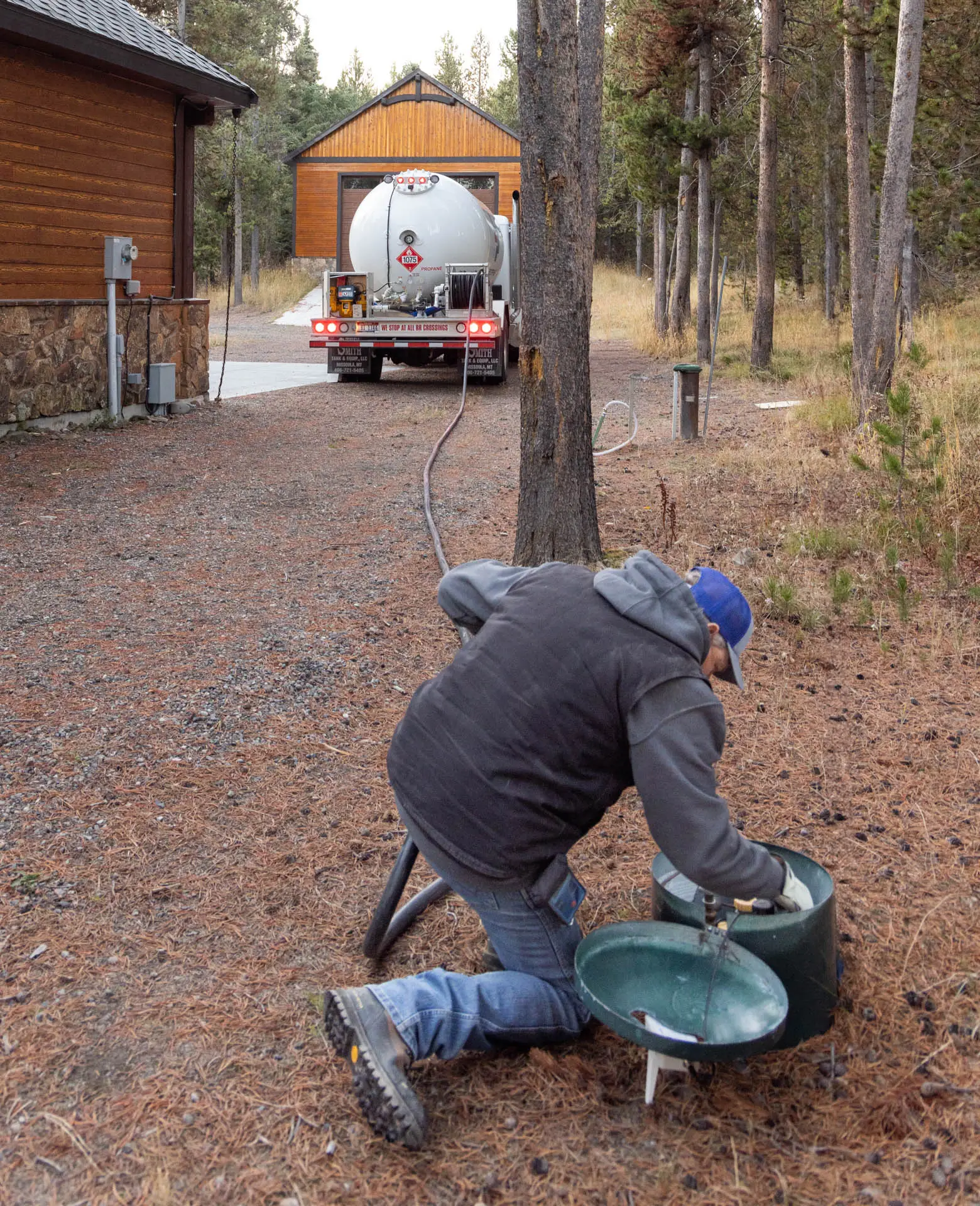
Tell your propane supplier that a generator shares the tank and provides its model, fuel ratings, and outage plan. Ask how emergency deliveries work and what lead time to expect. Automatic delivery based on ordinary household use may not anticipate 60 additional gallons per day during continuous generator operation.

Preserve Delivery Access

Keep the driveway, gates, and route to the tank accessible, and arrange snow removal when appropriate. Storm damage, flooding, downed lines, or blocked roads can prevent a delivery even when fuel is available. Do not make a seven-day plan depend entirely on an unconfirmed third-day refill.

Define Your Backup Decision

Choose what you will do if fuel falls toward the agreed reserve and delivery remains uncertain. Options may include reducing approved loads or relocating before safe heating or essential equipment becomes unreliable. Set that decision point in advance, especially when a household member depends on powered medical equipment.

Does a Full Tank Guarantee Continuous Backup Power?

No. Fuel capacity is only one part of prolonged operation. The generator also needs suitable regulators and piping, working controls, and maintenance according to its manual. Check the required oil-inspection and service intervals before the outage, since seven days of continuous operation equals 168 engine hours. Follow the manufacturer’s shutdown and cooling instructions before checks or servicing; never assume that “standby” means maintenance-free operation for an unlimited period. Have the installer explain how to manage any necessary maintenance interruption while protecting essential household needs.

What Safety Rules Apply During an Extended Outage?

Keep portable generators outdoors, at least 20 feet from homes, with exhaust directed away from doors, windows, and vents. Never operate one in a garage, even with the door open. Permanently installed standby generators require placement that follows their installation instructions and applicable codes. Maintain working carbon monoxide alarms with backup power, and never backfeed a home through a wall outlet. Do not use a propane grill or range for space heating. If you smell gas, leave and call for help from a safe location; if the tank runs empty, arrange professional checks and service restoration. 

Build Your Outage Plan Before You Need It

Start with your generator’s propane consumption, calculate several outage durations, and add the fuel your other appliances will need. Compare that demand with current inventory above a supplier-approved reserve, then confirm the tank and supply system can support simultaneous operation. Arrange delivery expectations, essential-load controls, maintenance supplies, and an alternative if replenishment becomes impossible. Review the plan before each storm season and after adding major appliances. That preparation gives you a realistic estimate of backup coverage and a clear next step when the outage lasts longer than expected.

BLAZING BLOGS

State Fair Giveaway

$500 Worth of Propane

Be one of the first 200 New Customers to sign-up until September 15th to get $500 worth of propane, FREE! You’ll also get 1 year free tank rental when you switch!

JOIN THE IGNITE PROGRAM

NEW CUSTOMER? Fill out the New Customer Application to join IGNITE.

Save $0.05 Per Gallon with the IGNITE Program Learn more!

This field is for validation purposes and should be left unchanged.
Name(Required)
Service Address(Required)
AAP Agreement(Required)
You will be contacted by a Customer Service Representative to obtain your credit card information.
Terms of Service(Required)

LP Propane Ignite Program – Terms and Conditions

1. Eligibility and Program Requirements
To qualify for and maintain enrollment in the LP Propane Ignite Program and receive the $0.05 per gallon fuel discount, the Customer must simultaneously enroll in and maintain active status in the following three core services:

Auto Fill Delivery: The Customer authorizes LP Propane to automatically monitor, schedule, and deliver propane to the designated tank when levels dictate, bypassing the standard Will Call scheduling requirements.

Auto Pay: The Customer must maintain a valid, authorized payment method on file (Credit Card, Debit Card, or ACH/Direct Draft). Invoices will be automatically drafted within 7 days after the delivery.

Paperless Billing: The Customer agrees to receive all invoices, statements, and program communications via email. Opting out of online billing or requesting paper statements will result in a $4.95 monthly fee and disqualification from the program.

2. Fuel Discount Terms

The $0.05 per gallon discount applies exclusively to the standard market rate of propane at the exact time of delivery.

The discount is applied automatically on invoice.

This discount cannot be combined with specific commercial contract pricing or volume discounts unless expressly authorized in writing by LP Propane.

3. Tank Monitoring and Delivery Access

LP Propane may utilize physical tank monitors or advanced usage-tracking algorithms to schedule deliveries.

Access Requirements: The Customer must ensure the propane tank is always completely accessible to delivery personnel and vehicles. The pathway must be free of obstacles, locked gates, debris, or unrestrained animals within a 100-foot radius.

Seasonal Maintenance: During winter months, the Customer is legally responsible for clearing snow, ice, and paths leading to the tank. If a delivery vehicle cannot safely access the tank, the delivery will be delayed, and any emergency filling fees incurred due to subsequent low fuel levels will be billed to the Customer.

4. Credit Status and Payment Failures

If an Auto Pay transaction is declined or fails for any reason (e.g., expired card, insufficient funds), the Customer must update their account billing details immediately. If the transaction remains unprocessed for 30 days despite attempts by LP Propane to contact the Customer, the account will be automatically unenrolled from the program.

If an account balance becomes past due, LP Propane reserves the right to suspend Auto Fill privileges, pause the $0.05 per gallon discount, and transition the account to a "Will Call / Cash on Delivery" basis until the account is brought current and after review and approval of LP Propane’s credit department.

5. Program Termination or Changes

Customer Termination: Removing any of the mandatory components (Auto Fill, Auto Pay, or Paperless Billing) constitutes voluntary termination from the program. If you would like to opt out of the Ignite program you must submit 30 day written notice

Company Modifications: LP Propane reserves the right to alter, modify, or terminate the Ignite Program framework, including discount amounts or underlying eligibility terms.

MM slash DD slash YYYY